Hi everyone!
I just wanted to let you know I have moved my blog. I've made my own website: keleneblake.com complete with blog. I've enjoyed having you here at "The Scent of Dying Roses" and invite you to join me at my new space Blackademically Inclined where I post weekly on topics of health, social justice, race, and my experiences as an international Black PhD student in a predominantly white institution. I've been consistently posting weekly since summer so there's a lot for you to read. I can also be followed on Twitter @BlackTygress and on my artist page on Facebook.
Thank you and see you soon!
Kelene :-)
About Me

- Kelene
- Writing, learn-ing, jewelry, deconstructing t-shirts and reality - it's what I do. I live to be inspired, and to inspire.
Monday, October 19, 2015

Sunday, April 6, 2014
Fixing Women Who Are Not Broken to Appease Men Who Are
I don't really pay attention to Steve Harvey's relationship
guru direction, or anything on TV in general, but I found this particularly
disturbing and I can't help but wonder why it is acceptable of anyone. In the
above clip a husband has extreme negative reactions to his wife's natural hair
when she takes a break from wearing weaves. Harvey playfully admonishes the
husband for not supporting his wife then brings in a "professional",
Nikki Walton to speak with them about natural hair. The "professional"
treats it as if it is all about the woman and her confidence and the whole fix
is to teach her new hairstyles. This is not okay.
It was disappointing and frankly upsetting how this
situation was handled. I don't generally care for conversations that treat
natural hair like an anomaly. This sort of conversation stems out of white
supremacy, an obvious legacy from this world's history, the consequences of
which are still, to this day, damaging and real. The concept that
"straight silky" hair is the norm and that other people with other
textures of hair are abnormal and ugly is an example. This is why grown white
people will ask me how I get my hair the way it is, because surely having hair
of my texture and shape is not natural and I must be doing something drastic to
make it all stand up like this. I always find it surprising that people can
grow to adulthood without the basic understanding that people have all sorts of
natural differences and not everyone's hair lies flat or is similar to theirs.
Unfortunately the "normalcy" of whiteness is so deeply ingrained in
so much of society that, even among the African diaspora, natural African hair
is treated with scorn - especially the shorter and more tightly curled its
texture. The natural hair of people of African descent comes in various
textures and lengths and is extremely versatile. Healthy hair is beautiful, no
matter what the texture, color or ethnicity of the person whose head it crowns.
It really should be that simple. Instead what we have is a devaluing of hair
that seems more "African" or "nappy" or "kinky",
and even in natural hair circles, people are encouraged to disguise the texture
of such hair to make it more wavy or to "tame" it.
I care passionately about a woman's right to own her natural
body, to love herself and be loved as she is without having to change her
natural features to suit a shallow and misguided society; which brings me back
to the above clip and why I consider it more damaging than helpful. The
husband in this story needs to be called out on his shallowness, his mental
slavery and overall horrible selfish, childish inconsiderate behavior. If
he can't let his lovely wife be herself at every stage of the "growing
process" he doesn't deserve her. Her hair is beautiful AS IS, at the
length and texture it is. All the styles offered as solutions are about either
hiding her hair or changing the appearance of it. It is not her fault her
husband is inconsiderate and ridiculous, though she literally states she feels
guilty, and she shouldn't have to "fix" her hair for the situation to
improve. This solution reinforces patriarchal ideas that the husband is not
responsible for his own behavior toward his wife, but rather she caused him to
behave that way towards her.
We are looking at a grown man here. He ought to have the
maturity to accept that he does not own his wife's hair, that she is taking
actions for her own true natural health and beauty, and that he needs to move
beyond shallow "white-is-right" ideologies to accept his wife for who
she is and not just how she looks. When he met her he knew she was a woman of
African descent and he had an idea of what her natural hair texture is like
because he has the same hair. The fact that he is repulsed by his wife's similar
hair texture to his own seems to demonstrate some self-hate. As a grown man he
needs to recognize and work on that. His wife also needs to work on her own discomfort
with her natural hair. Both need to journey to a place emotionally where they
can see each other and themselves in their natural state without the lens of
white supremacy, patriarchy or any other ingrained misconceptions
and judgments that teach them they are anything less than
beautiful and good. Anything else is simply not enough. Harvey and Walton are
putting band-aids over bullet holes and I refuse to condone such carelessness.
I have nothing against twist-outs, iron-outs or pin-ups.
Hairstyle is not the point (and if you think that is you've definitely missed
it). I do have something against people of influence reinforcing damaging
concepts or trying to fix women who are not broken to appease men who are. If
you know better, do better. If you don't know better, you better learn fast or
give voice to those who do know better. Band aids over bullet holes will not
produce the type of healing we need. Let's do the surgery necessary, dig deep
and find healing for ourselves and by extension our larger society.
Friday, January 3, 2014
The November Experiment: Health and Poverty
 |
| If "Health is Wealth" what does that mean for the poor? |
Now in doing this experiment I was
not going far off the road I am used to. I have been putting myself through
school and money has always been tight. Oftentimes I’ve had less to work with
and sometimes more. The purpose here was to get concrete information about
shopping with a set limit for healthy eating. As an educator I hope to use this
information to prepare health and wellness workshops for people in financial
hardship. During this time though, there were other things I learned too.
For one I learned there are some
psychological roadblocks that can be associated with or exacerbated by poverty
which a recipe list and mere shopping advice cannot solve. Anxiety and
depression can be triggered or exacerbated by the very real struggles of
poverty. This was well expressed here in a blog post by a woman living in poverty entitled “Why I Make TerribleDecisions, or, poverty thoughts.”
So in addition to caring for the
physical health of those with low socioeconomic status, we need resources
caring for their mental health. Taking care of oneself and one’s family is a
commitment that can truly be derailed when issues of depression and anxiety
overwhelm. Everything starts with the mind, health included.
The tangible limitations of the
cost of food can be worked around with the right MIND set and SKILL set.
Knowledge and application of what your body needs, what foods are healthy, how
to cook, how to shop for or grow them;
these are all important in overcoming the challenges of being healthy when
funds are scarce.
So it comes down to education: not
necessarily the institutional classroom and grades type, but the education
generations before us were receiving in the home, in the kitchen, the market
and the yard. In many U.S. families, for about 3 generations (both boys and
girls) have not been leaning how to cook for themselves and their families (here is Jamie Oliver’s TED talk about this). That
leads to a deficit contributing to poor health among lower socioeconomic
classes. If you are poor and do not know how to cook for yourself, you do not
have the money to pay someone else to prepare wholesome meals for you and your
family. You end up paying cheap fast food restaurants to cook for you instead.
You are stuck with low quality nutrition form the cheapest prepared food
sources: fast food and cheap processed bulk foods.
In order for us to truly address
the health of the socioeconomically disadvantaged we need to make available
resources for their mental health as well as help them develop the necessary
skill sets through education.
Truth is socioeconomic imbalance
should not even exist and is a symptom of the many things wrong with this world
and how it is governed and controlled. The argument that a poor person is
responsible for his or her circumstances because of laziness or poor character
is the highest level of bullshit. The deck is stacked. Those of us who have
knowledge and resources to do something need to look out for those who do not –
that is how we build and grow together. The November Experiment helped me gain
new insight into what I need to include in developing my strategy to help. I
hope it also helps you get a wider perspective of the issues of health and
poverty.
Sunday, November 3, 2013
The November Experiment a.k.a. Project “Don’t Starve. Thrive.”
 |
| Week 1 Groceries. Photo by Kelene Blake |
This month I am starting an experiment. Each week I will go
to the grocery store with only a $20 bill and attempt to buy healthy food to
last a week. People say that eating healthy is expensive and to some extent
that is certainly true. Buying organic tends to cost more. Healthier frozen
meals cost more. Yet I don’t believe that all healthy eating has to be
expensive, so I have given myself the challenge for November to eat healthily
5-6 times a day (3 meals, 2-3 snacks) on $20 per week. I’m doing this for 4
reasons:
- Because I told an acquaintance of mine that I would prepare a health workshop for low-income housing communities on eating healthy even with a low budget;
- Because this study (link) by Dr. Katz et al concluded that healthy food does not necessarily cost more and I want to see if it holds true for people with the tightest budget;
- Because many people’s food stamp benefits are being cut due to the U.S. government budget deadlock and people still need to eat, and eat healthily, but now have less money to work with;
- Because it’s just that kind of month (the kind where the less money I spend, the better). The struggle is real. But hopefully I can learn from it and benefit others too.
This isn’t a highly controlled research experiment. I am starting
off with some food already in my pantry – mostly rice and peas/beans,
seasonings, baking ingredients. This experiment is only for food and any
non-food items are not included in that $20 grocery list. What I am doing is a
real-world experiment. In the real world we don’t go to the grocery each week
with a blank slate. However the reality is some people do go to the grocery
store with very limited funds and they do their best with those funds to not go
hungry. They are forced by their financial restrictions to buy cheap bulk foods
just so they and their families have something to eat and avoid hunger pains,
even if that something has little nutritional value. Instead of foods rich in
vitamins, minerals, phytochemicals, fiber and other good things that help our
bodies function well, the cheapest foods in most grocery stores have mostly
empty calories, are nutrient poor and not particularly wholesome – made with
white flour, sugar, chemicals, preservatives and unhealthy fats. It is a
backward system where it is cheaper and easier to be unhealthy than healthy.
My hypothesis is that with $20 each week I can use the skill
set I have to prepare for myself healthy, tasty meals that are nutrient-dense,
full of vitamins, minerals, fiber, phytochemicals. It will be a mostly
plant-based diet but will still provide enough protein and healthy fats. It
will require more food preparation time than typical convenience foods, but
with careful planning and efficient use of time I will be able to fit it into
my schedule. I am hoping it will reveal what skills are most useful under these
circumstances so I, as a health
professional, can better educate the wider community. I also want to help those who have not experienced it understand some
of the basic health challenges of poverty.
I already have my first week of groceries as shown in the
photo. It came up to $18.91. I’ve already learned a bit in the process. I experienced
quite a bit of anxiety on the way to the grocery store; worrying about whether
I can actually do this, worrying what people would think of me, worrying about the
embarrassment of going over budget and having to ask to remove some items at
the cash register. That first worry I defied by actually doing it. The last one
I combated by plugging each item price into my calculator to check the total to
make sure I didn’t go over, and took note of which items were on sale to make
sure they weren’t rung up at full price. And the one worrying about what people
think… I came to the following conclusion:
When you tie your self-worth to how others think of you or
treat you, then you tie yourself to a burden that will inevitably drag you
down. Your worth as a human being, a creative, intelligent, magnificent
creature of this earth is intrinsic and unchangeable. No one can give you your
worth. No one can take it away. All that remains is for you to see and accept
your own immeasurable worth, wear it fearlessly and live your greatness.
The most difficult thing I learned so far is that in
addition to the tangible hardships of life, these anxieties are a constant part
of daily existence for many people in poverty. $20 U.S. a week, roughly $2.86 a
day, on food alone for a single person is still more than millions of families around
the world have to supply all their needs.
It is not fair. If this project can help people caught in this unfair
system to lead healthier lives even with financial restrictions, then that is far
more important than a little anxiety. I will keep you updated on this blog on
how this experiment is progressing. In the meantime I have some food prep to
do. Bless.
Monday, August 19, 2013
The Insanity of Health Disparities
 I knew from childhood I am susceptible to diabetes and have valued
and studied health to give myself the best chance of avoiding that life sentence.
I took for granted what turned out to be an important part of health – the certainty
I had some control over my own wellbeing. I understood my choices and actions
could affect how I feel and my health outcomes as I aged. Years of studying the
human body, how it functions and how it functions best, led me to the
conclusion that health is more than a personal issue, it is a social justice
one. I took a closer look at health from this perspective. Here is what I
found.
In the U.S., a person’s health is too often contingent on
factors such as socioeconomic status, race, gender and education. The more
money one has, and the more education, then the more likely you are to be
healthy and the longer you live. Generally women live longer than men but when
it comes to healthcare, women face unequal access and institutionalized sexism
in the healthcare industry. The most dramatic health disparities are the racial
disparities. In the U.S., African Americans, Hispanics, Native Americans and
Asian Americans all have disproportionally higher rates of chronic diseases,
higher mortality and poorer health outcomes than European Americans. Furthermore
these minority groups have less access to healthcare and receive inferior care
than European Americans.

The image shows graphs and information about life expectancy
from the CDC’s “Health, United States, 2011” report. It suggests that the life
expectancy for a black male in the U.S. is 8 years less than that of a white
male and 6 years less than a Hispanic male. Life expectancy for a black female
is six years less than for a white female and four years less than a Hispanic
female. This is by no means a full picture because Asian Americans, Native
Americans, Pacific Islanders and people of mixed race are left out; but it does
show the seriousness of health disparities in the U.S.
What does all that mean? Well it means that if you are a
rich white woman with at least bachelor’s degree in the U.S. of A. you’ve won
the health and lifespan lottery. If you are a poor black man who didn’t make it
through high school you’re at the bottom of the health and lifespan barrel as a
result of institutionalized classism and racism. Even then; despite the lifespan
advantage a female naturally has due to gender, her access to healthcare is
even lower than that of any male due to institutionalized sexism.
Health in the U.S. paints a messy picture and right now I am
a can of paint about to be splashed all over the canvas. I am embarking on a
career as a Health Coach and Educator and determined to make it more than “just
a job.” I don’t know if I can impact enough lives to make a tangible difference
in this situation, but I’m going to try. Five of the ten leading causes of
death in the United States are preventable “lifestyle” diseases (heart disease,
stroke, respiratory disease, diabetes, kidney disease) and a further four can
be influenced by healthy lifestyles (cancer, Alzheimer’s, influenza/pneumonia,
septicemia) this means 9 out of the 10 leading causes of death can be reduced
dramatically if people learn to lead healthier lives. I can help with that! (The remaining one is unintentional accidents.)
Institutionalized problems like racism, classism and sexism are
big issues and the journey toward change will continue to be long and arduous. While
that journey is taking place we can work from the ground up in changing our own
mindset and culture when it comes to health; that way we’re not dying off from preventable diseases while we wait for the insanity of these inequalities to be
fixed. I will not place the onus of oppression on the oppressed.
Institutionalized racism, classism, and sexism all must be fought and done away
with. Yet, I will use the one advantage I do have, my education, to wage battle
on this problem from where I stand. That’s something we can all do isn’t it? We
can use the gifts we have to make a difference where we are – improve our own
lives, the lives of our loved ones and extend to our community. Hopefully if
enough of us care enough to make a difference, the whole world can be different
(better).
Sources:
CDC’s “Health, United States, 2011” report
Chapter 24. Health and Medicine. Introduction to Sociology. Cragun
R., Cragun D., Konieczny P. (Open source)
Chapter 19. Health and Medicine. Introduction to Sociology.
Openstax College. Rice University (Open source)
Saturday, June 15, 2013
Overcoming "Normal"
“Normal is an illusion. What is normal to the spider is
chaos to the fly.” ~Morticia Addams

It’s normal for a men to be given more money and resources
than women. It’s normal for African-Americans to have lower incomes, health and
education. It’s normal for a woman to put her husband and family above her
personal needs, goals and dreams. It’s normal for a man to put his own sexual
desires ahead of respect for a woman. It’s normal for certain people to be born
into privilege, have more economic and political power, and for certain other
people to be born into poverty and live the “hard life.” It’s abnormal to love or
marry outside the bounds set by religion, law, caste, class or race. It’s
abnormal for a woman to not be interested in pursuing marriage or to not want
children. It’s abnormal for a young black man to be more interested in writing
poetry than playing sports; abnormal for to walk down the street in an “English-speaking”
country and hear residents speaking languages other than English. It’s abnormal
for someone “different” to not want to assimilate, give up their culture and
beliefs to be more like the dominant class.
Injustices, inequalities, discrepancies and double standards
are passed off as normal – just the way it is – and people’s freedoms and
rights are infringed on the basis of them not falling within the dominant class’s
category of normalcy. Sometimes people are so afraid of change that they fail
to realize that the “norm” is not the ideal but is actually oppressive to many
groups. But when the current system gives you an advantage or stability, it is
difficult to see its flaws. Even those on the wrong side of those flaws may
resist change because, as the saying goes, “better the devil you know than the
devil you don’t.”
Yet the “natural order” of things is not so “natural.”
Humans have created these norms through patterns of domination and strategy,
decisions and actions over the course of history. If we so haphazardly and very
carefully created this world of haves and have-nots, then we can create a
better one. People with power and privilege are not likely to want to change a
system that gave them power and privilege, so we really need to stop waiting
for those people to “do something.” Such people will appease the masses by
giving an inch as they continue to take yards and yards.
One of the first things we need to do is change the way we
think. If more people examine themselves, their biases, stereotypes,
conditioning and apathy we can stop thinking what we’re taught to think and
start thinking critically about the world around us. Critical thinking allows
us to question the norms, recognize their flaws, change our behaviors and find
solutions. It is crucial to transition from thinking to action.
Changes in
our every-day behaviors, choices, how we spend our money, how we treat others,
all baby steps in creating a better world around ourselves. Actions that extend
beyond, teaming up with others in finding solutions that can have positive
impact on a larger scale, is also a big part of re-writing the norms. It’s
important to focus on things you can do rather than get frustrated by what you
cannot do (right now). The process is slow and uncomfortable – quite opposite
to the convenient instant gratification that consumer society is trying to make
into the “norm” at the expense of many around the world.
Sunday, June 2, 2013
Doing More With Less
 Things are tight and many of us are learning to do more with
less. There are things we all want to do one day. Dreams. Goals. When trying to
accomplish something you need to be prepared to do so “in spite of.” The time
will never be perfectly right. You will never be perfectly ready. What we often
fail to realize is that achieving our goals isn’t a one-off effort: it is the
culmination of many, many little efforts over a long time.
There are always
little things we can do every day that lead up to those goals. Some of these
practical things can be tangible – like registering a business name or writing
a blog post. Others are less tangible like reading a book, working out a
timeline or putting aside money each month.
Money is the first thing many people cite as the reason they
cannot chase after their dreams or achieve certain goals. Saving and making
good decisions about money is important. Too many people have a mindset of
getting debt and taking loans. This culture has turned debt and credit into a “good”
thing that “responsible” people are expected to have. Horse-shit! I’m not a
financial advisor but I am practical about money which is one of the reasons
I’ve survived this long. The first and foremost thing I’ve learned is to avoid
debt like the plague – save up for what you need or want. Below is some saving
advice that can help you accomplish a lot with a little over time. It assumes
you have an income – however small, large or indifferent.
· Before anything else: subtract 10% of your paycheck every month for savings. This first 10% is savings. It may be savings for a specific purpose (like a car etc) or in case of emergency (like unemployment). Do not touch it for any other reason! Put it aside then figure out how to live the rest of the month without it. If you have to eat nothing but rice and beans for a while then so be it.
· If you can do a second 10% then put that aside as investment/givings. This is multi-purpose and a bit more flexible, but still not for bills and typical life expenses. Put it into your children’s or nieces and nephews mutual fund or college savings; put it aside to invest in your future business plans; or give it to whatever cause or charity you feel like contributing to. Heck! Split it up and do all three of these things if that 10% chunk is big enough. Point is use it to invest for the future, your community, and to make a positive difference.
· Next: pay your rent and bills. Include in here payment for credit card and loans. Do not pay only the minimum on debt. Pay as much as you can spare to get rid of debt. Debt is a blight you need to get rid of as soon as humanly possible.
· Buy groceries. If you plan meals, buy groceries and budget for food monthly, you’re less likely to end up eating out (spending extra/wasting money).
· If there’s any remaining, the rest is your disposable income. Dispose of it as you wish and try to have some fun. Sometimes you won’t have this and your entertainment might have to be staying in and reading a library book. That works too.
I know it doesn’t sound exciting; being smart and cautious
never does. But savings and investment are truly important and key in helping
you make things happen. You are in control of your money. It isn’t some willful
thing that comes and goes into your life like an on-again off-again
relationship. It is something you work with logically, not emotionally, and you
make it work for you.
Saturday, May 25, 2013
Starting & Finishing
The two most difficult parts of any endeavor are starting
and finishing. Starting because it’s so filled with uncertainty, you don’t know
what to expect, there’s a lot to make you anxious and afraid, sometimes enough
to leave you paralyzed and unable to actually begin. There are the times you
just have to jump in. You can submerge yourself like you’re trying to
acclimatize to cold water at the beach. Or you can ease in, step by step, phase
by phase until you are fully covered. Once you’ve made that first step despite
the fear, uncertainty and challenges you have conquered a major part of the
struggle.
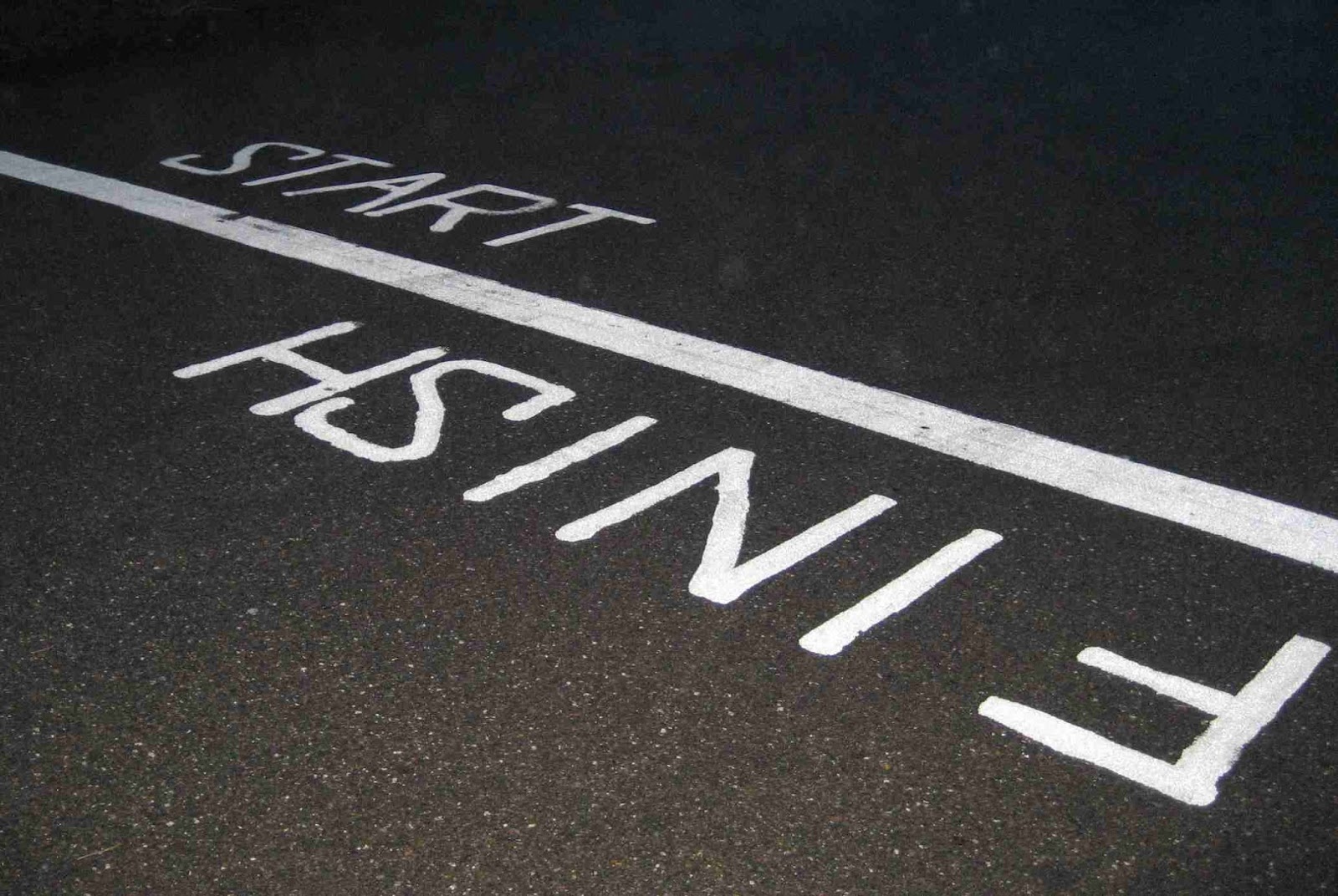 Ending is also frightening because things can become
overwhelming. I noticed a pattern at the end of both my undergrad and masters
degrees. It was as if I suddenly developed some sort of attention deficit
disorder and became unable to concentrate. It had a lot to do with anxiety for
me. I have to force myself to do what I need to do to finish. I constantly have
to tell myself “One last push, you can do this. Don’t stop now.” That last hill
we climb can be a doozie.
The two hardest things are starting and finishing – yet they
are the two most important things. Good intentions and ideas are nothing until
you take action. Then when you start you need to follow through and finish. Giving
up is not necessary and simply cannot be an option if something is important to
you. Procrastinating, or not finishing leave you with a burden at the back of
your mind. You drag this burden along and can get stuck. It can hamper forward
movement and growth if you leave things unresolved. The psychological freedom
of having resolved something gives you space to move forward and continue
positive growth rather than staying stuck.
The thing with ending is that when one thing ends, something
else begins. For me, when masters ended I officially became unemployed and my
job search began. That in itself is scary and technically I haven’t properly
started yet: still updating my resume and that sort of stuff. But again, I’m at
that scary starting point. Uncertainty seems to be life’s only certainty –
because everything has a start and an end, both of which are covered in the
stuff.
So I guess the best thing to do is realize this is how it
will always be – there will always be fear and uncertainty at the beginning,
ending, and all up in the middle of everything you do in the construction and
creation of your life. The thing is to not let that fear and uncertainty
paralyze you – keeping you from starting and ending. We can take a note from
the book of artist Georgia O’Keefe who said “I’ve been absolutely terrified
every moment of my life and I’ve never let it keep me from doing a single thing
that I wanted to do.”
So go on. Get started. Get finished. Fear ain’t shit
compared to what you have to offer the world.
Friday, January 25, 2013
Kneading Dreams Part 2

Last week I posted the first of this two part list of
lessons learned from making bread. (I know, that’s a bit random, but my mind
wanders.) Here’s lessons 6 to 10 of that list:
6. Bonds will break. New bonds will form.
For the ingredients to become dough a chemical process takes
place. Bonds are broken and formed with the mechanical energy provided by your
kneading. Before you get where you need to be bonds need to be broken; new
bonds need to be formed. Some of these bonds to be broken can be daily vices;
your love for television or junk food, your hours spent gaming or social
networking. Time-sucks, health sabotages, toxic behaviors and thoughts need to
be cleaved off or at least minimized and controlled. Some of these bonds can be
toxic people who are negative, who don’t like what you’re trying to do and make
that a burden for you, who encourage you to do the toxic things you want to
stop doing. Sometimes you may have to end the relationship. Sometimes it’s just
a matter of minimizing contact: stop hanging around them, avoid talking or
listening to them, become too busy to spend as much time in the toxic environment
they bring. Form new bonds. Find like-minded aspirers. Find people who have
achieved what you want to achieve. Find people who encourage and support you.
Take up new habits. Break and form the bonds, habits, attitudes and behaviors
that will take you where you want to go.
7. Give it time to grow.
You probably figured out from #6 that making bread takes
time, it’s no cake-walk (though making cake has its challenges too). Reaching
big goals takes time. The bigger the goal the more time. Bread can take one or
two hours. Forming healthy habits can take months. Other goals – years. But the
time was going to pass anyway, with you living the way you live now,
accomplishing nothing new, so you might as well do something with that hour,
those months or years that will result in accomplished dreams (or food for the
week). But when you start toward your goals and dreams be in it for the long
haul. Know that things do not happen instantly: you need to put your time in
before you get something good out.
8. Be prepared to face the heat.
There’s always one last challenge. In order for the dough to
become bread you have to apply heat. To make a diamond it takes high
temperature and high pressure. To become more than the sum of your parts you
need to face the hardships and obstacles – I prefer to call them challenges –
that come your way right up to the end. There is often going to be a point when
you’ve done everything, you’re almost there, destination in sight, and
something will challenge you. This is when people often quit. You don’t. You
never know which hurdle is the last but keep jumping them or ploughing through
them until you get to that finish line. Your destination is real, keep moving
towards it.
9. Pace yourself. Don’t get burned.
In addition to killing the yeast my first time I also burned
the bread. Well actually the recipe I had told me to wait a length of time
during which the bread burned. Needless to say I tweaked that part of the
recipe as well. But it just goes to show, someone else’s timing may not be the
right pace for you. Some people can make it on 4 hours sleep a night for years
while others need that 7 or 8 hours to function. Work with your own needs, your
own pace. Sleep, eat, take breaks, relieve stress as needed. It’s not a failure
or a weakness to have to pause and catch your breath. In fact if you’re pacing
yourself correctly you won’t have to stop to catch your breath because you’re
working at a pace that fits your level of endurance. Indulgence, laziness,
procrastination get you nowhere. But pacing yourself gets you where you need to
be intact. You’re going to do a lot of growing and changing in the heat. You
need to make sure the process doesn’t destroy you.
10. Enjoy the smell
There is nothing quite like the smell of freshly baked bread.
It is the smell of comfort and warmth. For me it’s the smell of achievement. I
will eat well this week. Enjoy the journey and the destination. The process is
difficult. It’s rough. It’s stressful and tiring. But often time there’s
nothing else you’d rather be doing because you’re doing the work of building
your dreams. But in the heat, when you get those initial whiffs of success, you
know you’ve done it, you’re doing it, and it’s worth it.
Photo by Kelene Blake: Yes it looks plain on the outside but it's filled with yummy spinach-y, tomato-y, mackerel-y goodness on the inside!
Friday, January 18, 2013
Kneading Dreams
Last Sunday, my baking day, I made my
first batch of bread for 2013. When you’re making bread by hand – kneading the
dough until it is ready to be put aside so it can rise – you have a lot of time
to think. I’ve learned a lot from baking, and from last year when life sent me
in the strange directions that led to me baking my own bread among so many
other things. Here are a few life lessons I came up with while kneading dough:

1. Figure out what you need before you begin.
In making bread and plans I’ve learned to be strategic. In both cases I learn from my mother and my friends. You can learn a lot from others’ experiences. Sometimes gathering the right resources can take time. Sometimes you have to find alternatives. But it is important to understand what raw materials you need – whether it is the right groceries, the technique, the equipment, the knowledge, the mindset – and get it if you are going to start right. Without the ingredients there will be no bread.
2. Begin
Jump in. I had been saying I want to bake my own bread for an embarrassingly long time before I actually got around to it. Procrastination is a tempting beast. If it is not pressing, required for basic survival, routine or crucial for maintenance of our precarious position in life, we will likely put it off. The only way to beat procrastination is to just start. Catch it by surprise. “Do it while you’re thinking about it” as my former professor M.K. Asante used to say. It’s like when you first step into a swimming pool or the water at the beach. It feels cold on your feet, so the best thing to do is just override you hesitation and submerge yourself. Whether your intent is to start a new career, start exercising, change your diet, pluck your eyebrows… whatever it is you’re putting off, start it now. Right now. You can come back and finish read this post after you’ve started.
3. Shit will happen. Learn from it.
I scalded the yeast to death with boiling hot water the first time I tried to make bread. The dough didn’t rise and the end result was barely edible rock bread. Since then, I’ve made sure to not do that again. I made a mistake. The world didn’t end (Take that Mayan calendar folks!). It made me better at what I was doing. We are programmed to fear failure. We’re bombarded with images of success, stories about the best, pressure to learn quickly and make the grade at the appointed time. We forget one of the most basic methods of learning is through trial and error. There is nothing wrong with not getting it easily the first few times. Each mistake is shedding the skin of inexperience. Be okay with it. Be patient with yourself. You’re learning.
4. Follow the recipe the first time, then tweak it.
I combined my Mom’s and my best friend’s recipe to make my bread. Then I further tweaked it to include honey and to enhance the fatty acid profile. Eventually I developed my own style of sandwich bun which I love. Other’s paths are not necessarily your path. You can learn from them, get the lessons, but there is no need follow fashion. Infuse yourself into everything you do. You already have your own knowledge, your own wisdom, and your own preferences. If you’re doing something for yourself, find out how it’s done, then do it your way. If you live your life always following other people’s instructions you will eventually question yourself and think you cannot do anything without instructions. Who wants to be that person?
5. Give it time to come together.
At first when you start kneading things are messy. The ingredients don’t automatically turn to dough. The first couple minutes you wonder if you did something wrong, why things are not coming together like they’re supposed to. Maybe you did make a mistake. This would be the time to figure out what’s missing and put it into the mix. But if you have the right ingredients in there, all you need to do is keep pushing and eventually things will come together and make sense. In any major overhaul in life you have to make a mess before you clean up. That’s why change is so frustrating. The first few times you exercise your muscles hurt. If you continue you’ll find they got stronger and they don’t hurt any more. But you only get that if you continue. If you give up at the first sign of pain, the first sight of a mess, the first hurdle, there is no way you are going to make it to your goal. Plough through until you get to the other side.
To be continued. Check back next week for 6 to 10!
Photo by Kelene Blake: One of my early attempts at making bread.
Saturday, October 6, 2012
Simply Speaking
 Living simply can seem pretty complicated. It’s quite the
oxymoron. How we live seems set up to discourage a simple life and encourage a
highly consumeristic lifestyle in which we are constantly thinking of the next
thing… the next thing we want to buy, the next thing we want to try, the next
thing we need to do to become the person we’re trying to become: usually
modeled off of someone we see on t.v. (Just
think about how many people want a family like the Obamas.)
We’re so used to living lives of convenience, conformity and
consumerism that the things which would make life simpler like shutting off
cable, cooking from scratch, eating healthier, walking or riding a bicycle
instead of driving, buying less, reusing more, seem far more difficult than
they actually are. Our minds seem primed to reject things that attest to our own
self sufficiency. We are so indoctrinated in capitalist thinking that if it is
a product or service that can be bought, why do it ourselves?
As a student making my own way through grad school without a
college fund, I’ve been forced in many ways to simplify my lifestyle. What I’ve
found however is much of the “downgrading” I’ve had to do were really
upgrades. My need to eat for less encourages me to cook for myself, find ways
to curb food wastage and to appreciate the finer tastes of simpler things. I
eat healthier, plan my meals, make better decisions and try new things. I’m
certain my fitness is improved because I either have to walk, ride or travel
everywhere I go. I am less distracted and more creative without television, and
when I do take time to watch something, it will always be something I really want
to see that either educates me or enriches my experience. I can’t afford (in
more ways than financially) to watch junk.
The amazing thing is I am never bored. All those hours
spent on consumeristic behavior, watching television, eating out, shopping for unnecessaries,
are being spent learning new things, making definitive steps in pursuing my
dreams, making and creating, writing, experiencing other people’s art and
thoughts, and sharing mine. I wonder how different my life would have been if I
had the luxury and habit of living that consumer lifestyle. How much would I be
missing if I spent hours a day in front of a television, or buying
unnecessaries or saving time with fast food?
I can’t afford everything I’d like such as plane tickets to
visit family and friends, or funding creative or social projects that can make
an impact in the world. But I can afford to live simply, fully and enjoy rich
experiences. Money is a useful resource and I hope to increase my access to
that and other resources as I grow in my career. But learning to live simply
has taught me many valuable lessons, such that when I do have access to
opportunities and resources, I’m better equipped to use them in ways that truly
matter. If you can live and love your life when you have little, perhaps you can
invest more in making a positive difference in the world when you have a lot.
Monday, September 10, 2012
Storytime: How I Met Poetry
You never know where you will find life-changing inspiration. This is why it is good to be open to even the most simple, trivial things and follow the crumbs of inspiration wherever they lead. These days my life is all about poetry. In 2012 I’ve written and performed more poetry than in any other period of my life. I’m searching for a publisher for my book and working on to making a life doing what I love. And you wouldn’t believe that what really set me on this path was Saturday morning cartoons.
Yes. That’s right. As a child I met Poetry while watching a particularly riveting episode of Batman in which Catwoman was transformed into a real cat-like creature with fur and whiskers and everything… but I digress. At the end of that episode I heard a line of poetry that would open my world to a life of artistic expression. Here’s the clip:
I was so fascinated by this line of poetry that I stayed around to read the credits and found out it was “The Tyger” by William Blake. The fact that the writer’s name was “Blake” made me even more interested (I was still young so I thought everybody with my last name was family). I kept the information filed away in my mind with the hope of one day searching for the full poem.
It was quite a long time before I was able to find it. The internet was not at my fingertips back then. But I eventually got a hold of the words, and never let them go since.
Tyger! Tyger! burning bright
In the forests of the night,
What immortal hand or eye
Could frame thy fearful symmetry?
In what distant deeps or skies
What immortal hand or eye
Could frame thy fearful symmetry?
In what distant deeps or skies
Burnt the fire of thine eyes?
On what wings dare he aspire?
What the hand dare seize the fire?
And what shoulder, & what art.
On what wings dare he aspire?
What the hand dare seize the fire?
And what shoulder, & what art.
Could twist the sinews of thy heart?
And when thy heart began to beat,
What dread hand? & what dread feet?
What the hammer? what the chain?
And when thy heart began to beat,
What dread hand? & what dread feet?
What the hammer? what the chain?
In what furnace was thy brain?
What the anvil? what dread grasp
Dare its deadly terrors clasp?
When the stars threw down their spears,
What the anvil? what dread grasp
Dare its deadly terrors clasp?
When the stars threw down their spears,
And watered heaven with their tears,
Did he smile his work to see?
Did he who made the Lamb make thee?
Tyger! Tyger! burning bright
Did he smile his work to see?
Did he who made the Lamb make thee?
Tyger! Tyger! burning bright
In the forests of the night,
What immortal hand or eye
Dare frame thy fearful symmetry?
What immortal hand or eye
Dare frame thy fearful symmetry?
This beautiful poem, written in 1794 turned me on to a form of expression that has since saved my life and sanity many a time. You can still see the influence in my handle, JadeTygress. Who would have thought it? I had childlike wonder on my side which allowed me to wonder at the crumbs and follow them to inspiration. No one says you have to let go of this childlike wonder as you grow up. Capture inspiration in the every day. You’ll never know where it will lead unless you follow.
Friday, July 27, 2012
Walls
Been playing around with some footage from my poetry feature in January of this year. Here's a clip of me performing my poem "Walls".
Sunday, July 1, 2012
The hardest part
 |
| Beautiful ruins: Photo by Kelene Blake |
by Kelene Blake
The hardest part
is wearing the scars
The hardest part
is wearing the scars
as
stripes of honor
not
a shield
engraved
into skin/ mind/ heart
evidence
of what you’ve overcome
memoirs
of the times you’ve bled
reminders you are strong enough
to
heal
The
hardest part
is
leaving the hurt behind
taking
the lessons forward
escaping
oppression
not
as victim
as
a graduate
your
commencement
rebirth
into a brighter you
emerging
from confined cocoon
The
hardest part
is
the uncertainty
embracing
it wholeheartedly
not
knowing where your feet will take you
after
they’ve taken you through hell
there
is no unlearning what you’ve seen
there
is no un-being who you’ve been
there
is only creating
who
you will become
The
hardest part
is
letting go
letting
grow
letting
feel
letting
heal
letting
blood
letting
love
letting
yourself
live
Subscribe to:
Posts (Atom)